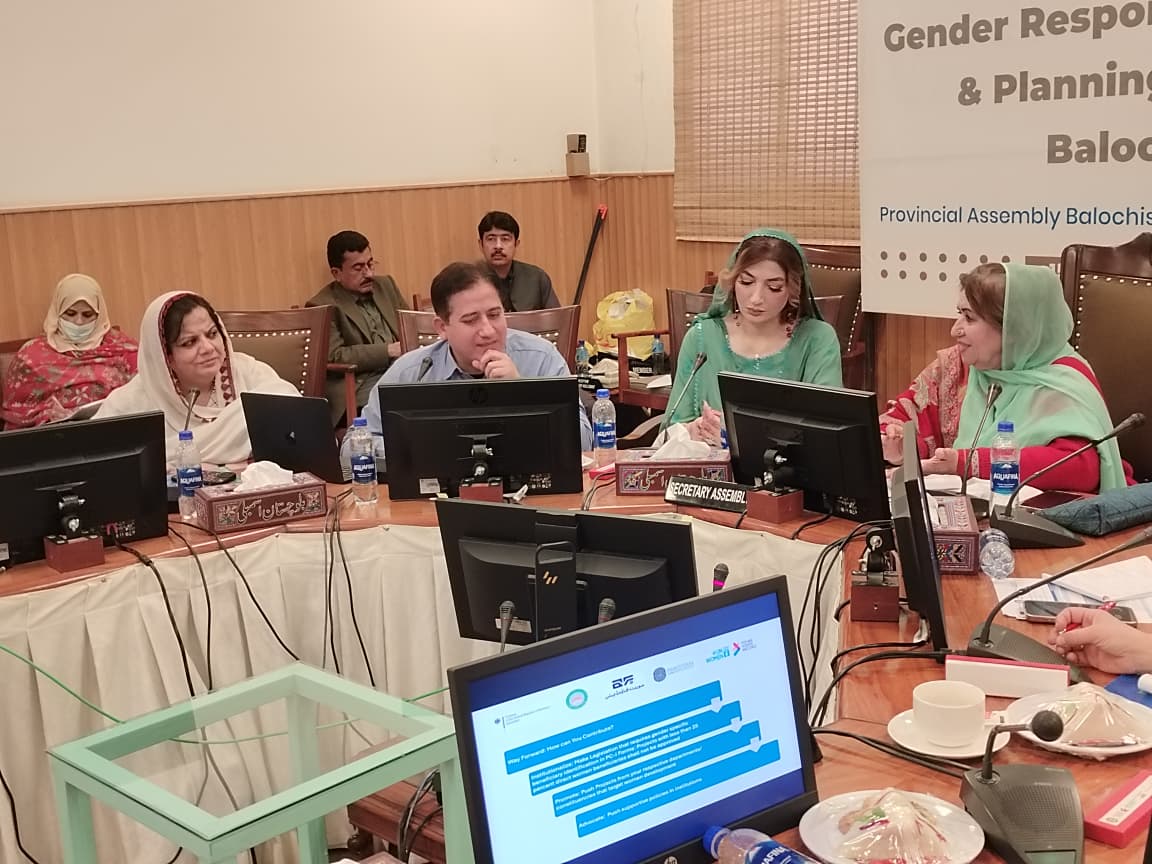
Quetta, A consultative session on gender-responsive budgeting and planning was held at the Committee Hall of the Provincial Assembly of Balochistan, bringing together representatives from various government departments and institutions. The session aimed to promote equitable resource allocation for women and men and to strengthen good governance in the province.
The session was organized by the Women Parliamentary Caucus (WPC) Balochistan in collaboration with UN Women and Aurat Foundation, with financial support from the German Embassy and the European Union Pakistan. Distinguished participants included Deputy Speaker Ghazala Gola, Provincial Minister for Education Raheela Hameed Durrani, Members of the Provincial Assembly Farah Azeem Shah, Salma Kakar, Shahida Rauf, and Safia Umrani, Secretary Assembly Tahir Shah Kakar, Director General Social Welfare Ashraf Gichki, Provincial Ombudsperson for Anti-Harassment Tahira Baloch, Head of UN Women Balochistan Ayesha Wadood, Regional Director Aurat Foundation Alauddin Khilji, Additional IG Police (Gender) Asrar Ahmed Umrani, Member National Commission for Human Rights Farakhanda Aurangzeb, UN Women Technical Expert Dawood Nangyal, Program Officer Yasmin Mughal, development expert Muhammad Ahsan Achakzai, SHO Women Police Station Zargona Tareen, along with representatives from the Health, Finance Department, Planning and Development Department, Law Department, Women Development Department, Ministry of Human Rights, academia, development partners, and civil society.
The session commenced with participant introductions, followed by a presentation of the session objectives by a representative of UN Women. In their opening remarks, representatives from UN Women, Aurat Foundation, and the Provincial Assembly Secretariat highlighted the importance of gender justice, good governance, and equitable distribution of resources. Deputy Speaker and Chairperson of the Women Parliamentary Caucus, Ms. Ghazala Gola, welcomed the participants and appreciated the collaboration, stating that the session reflects joint efforts to strengthen gender-responsive governance and institutional capacity in Balochistan.
She emphasized the importance of gender-responsive budgeting, noting that effective participation of women in leadership and decision-making processes is only possible when their needs and concerns are adequately reflected in budget planning. She clarified that the purpose of this approach is not to create separate budgets for women, but to ensure fair and balanced allocation of resources.
During the session, Muhammad Ahsan Achakzai delivered a detailed presentation on the budget cycle, gender analysis of the Public Sector Development Programme (PSDP), budget review, and effective monitoring mechanisms. Participants were guided on how to integrate gender considerations at every stage of the budgeting process to achieve better outcomes, particularly for women in rural and underdeveloped areas of Balochistan.
The discussion also focused on key challenges faced by women in the province, including access to education, healthcare, economic opportunities, and protection from violence. Participants emphasized the need for evidence-based and inclusive budgeting to address the needs of women in marginalized areas.
Provincial Minister Raheela Hameed Durrani highlighted the seriousness of issues faced by women and stressed the need for collective efforts to address them. She noted that development schemes proposed by women members are often limited or excluded in the PSDP, and that funds allocated for women are frequently reduced. She added that women representatives, like their male counterparts, are accountable to their constituents and must continue their struggle based on facts. She acknowledged the support of male colleagues, particularly the Chief Minister of Balochistan, and emphasized the need for collective support to address shared challenges.
The Women Parliamentary Caucus reaffirmed its commitment to playing an effective role in the budgeting process, advocating for gender-equitable resource allocation, and strengthening accountability in legislation. Members of the Assembly were encouraged to enhance budget scrutiny and oversight through standing committees.
The session agenda included expert discussions on stages of budget formulation, gender analysis of development budgets, and strengthening monitoring systems. The role of the Women Development Department, policy implementation, and inter-institutional coordination were also highlighted.
Through interactive discussions, participants identified priority areas and developed joint recommendations aimed at improving budget allocations in line with gender needs and strengthening the role of the Women Parliamentary Caucus in legislative and budgetary processes.
Expected outcomes of the session include improved interdepartmental coordination, enhanced capacity of legislators, stronger advocacy for women’s rights and priorities, and effective monitoring of budget implementation. Participants stressed the importance of institutionalizing gender-responsive budgeting within government systems.
Ayesha Wadood of UN Women stated that women members of the Balochistan Assembly are representing the women of the province.
MPA Farah Azeem Shah remarked that parliamentarians are responsible for legislation and highlighted the issue of placing the right person in the right job. She stressed the need to review the implementation of assembly resolutions and reaffirmed commitment to collective efforts, ensuring community participation in line with Pakistan’s values.
In her closing remarks, the Chairperson of the Women Parliamentary Caucus emphasized that equitable and inclusive budgeting is essential for sustainable development and long-term prosperity in Balochistan. She thanked all participants and reaffirmed the commitment to continue such efforts.
Comments 0